
 By
By 
Suggested featured image / thumbnail.
TL;DR
Short version: external traffic is scored, not counted, and traffic that arrives and leaves teaches the marketplace that your listing does not convert. |
There is a version of Merch promotion that consists of posting a link in large places and hoping. It reliably underperforms doing nothing, and the reason is worth understanding before you spend anything.
Marketplace ranking responds to conversion. A thousand people who arrive, glance and leave do not simply fail to buy. They lower the conversion rate on the listing, which is one of the inputs deciding whether the listing gets shown to the people who would have bought. Untargeted traffic is not neutral. It is a cost paid in ranking.
The full channel-by-channel workflow is set out in this guide to how to promote Amazon Merch on Demand listings.
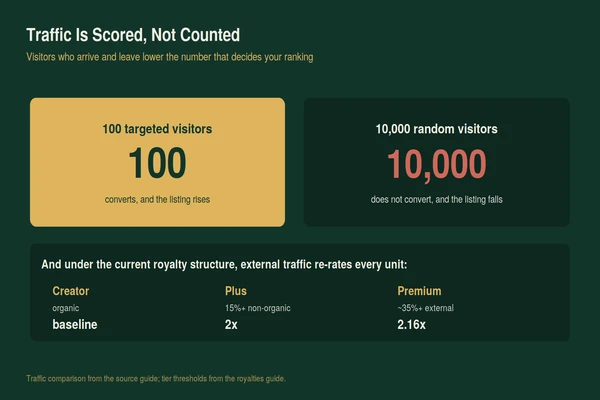
The wrong ten thousand cost you twice: no sales, and a lower conversion rate on the listing.
Fix the Listing Before You Send Anyone to It
The highest-return promotion work happens before any traffic moves, and it is unglamorous.
Custom mockups. Replacing a flat product render with a mockup showing the shirt on a person, in context, can lift conversion by up to 30%. That figure applies to every visitor the listing already receives, which makes it a better first investment than any campaign. It costs an afternoon.
Title clarity. The title has to make sense to someone arriving from Instagram who has no idea what they are looking at. A title optimized purely for marketplace search often reads as keyword soup to a social visitor, and the two audiences arrive at the same page.
Product type and price. A design that sells at $19.99 on a tee may sell better at $34.99 on a hoodie to the same audience. Test before you promote rather than after, because promotion amplifies whatever the listing currently does, including converting badly.
The Influencer Range That Works
The useful band is 1,000 to 50,000 followers, and the reason is not budget.
At that size the relationship between creator and audience is specific. A 4,000-follower account built around trail running reaches people who will recognize a trail-running joke on a shirt. A 900,000-follower general lifestyle account reaches a demographic, which is a different and much weaker thing to reach with a niche design.
The mechanics that matter are two. Pick creators whose theme actually matches the design rather than whose numbers are attractive. And use trackable links wherever the platform allows, because without them you are running the campaign blind and will not be able to tell a good creator from a lucky week.
The Disclosure Rule, and Whose Problem It Is
If you gift product to a creator, a legal obligation attaches, and sellers routinely assume it attaches only to the creator.
The FTC’s Disclosures 101 for Social Media Influencers, which is standing guidance rather than recent news, is direct about the trigger. A “material connection” to the brand “includes a personal, family, or employment relationship or a financial relationship, such as the brand paying you or giving you free or discounted products or services.”
Free product counts. The guidance is explicit that “if a brand gives you free or discounted products or other perks and then you mention one of its products, make a disclosure even if you weren’t asked to mention that product.” So the gifted-shirt play, which is the standard low-budget move in print-on-demand, is squarely inside the rule.
It is also specific about placement: disclosures “are likely to be missed if they appear only on an ABOUT ME or profile page, at the end of posts or videos, or anywhere that requires a person to click MORE,” and it warns against mixing the disclosure “into a group of hashtags or links.” What does work is simple: “terms like ‘advertisement,’ ‘ad,’ and ‘sponsored,'” or a plain line such as “thanks to Acme brand for the free product,” placed where it is hard to miss.
The guidance puts the duty on the influencer, telling them “it’s your responsibility to make these disclosures… Don’t rely on others to do it for you.” That does not leave a brand comfortable. An undisclosed material connection can make the endorsement a deceptive advertisement, and the product being advertised is yours. The practical answer is to say in writing, when you send the shirt, that you expect a clear disclosure. It costs one sentence and it removes the ambiguity for both sides.
Where the Traffic Actually Comes From
Four channel families, with different shapes.
Visual social. Instagram, Pinterest and TikTok suit a design-led product because the product is the image. Pinterest in particular behaves more like a search engine than a feed, which means a pin can keep working months later.
Communities. Subreddits, Facebook groups and Discord servers reach exactly the people a niche design was made for, and they are the least tolerant of overt selling. The entry cost is participation rather than money.
Niche blogs. Slow, small and durable. Worth pursuing only where the niche has a genuine publication behind it.
Paid. Facebook ads and Amazon PPC both work and both punish imprecision. Paid traffic that is badly targeted is untargeted traffic you also paid for, which is the worst of both.
The Part That Changes the Return
There is a second reason to run external traffic, and under the current royalty structure it is arguably the larger one.
Merch royalty rates are tiered by traffic mix. Qualifying non-organic traffic at 15% or more of monthly units moves a seller from the Creator group to Plus, and roughly 35% reaches Premium. Those tiers are not a bonus on the units the promotion brought. They re-rate the royalty on every unit sold that month, organic ones included.
Which means the honest way to evaluate a promotion is not the sales it generated. It is the sales it generated plus the difference in royalty on everything else, and for a seller with real organic volume the second term is usually the bigger one.
The corollary is uncomfortable and worth stating: the thresholds are monthly. A promotion run once is a good month. Promotion run as a habit is a different royalty rate.
Start With One Design
The way to begin is narrow. Take your single best-converting listing, rebuild the mockup, and send one small, well-matched audience at it.
Then watch two things for a fortnight: whether conversion held, and whether organic impressions moved. If conversion held, the audience was right and you can repeat it. If conversion fell, the traffic was wrong, and sending more of it would have made things worse rather than slower.









Comments